World models are having a moment. After a decade as a mostly academic idea, they have surged to the center of the AI conversation. Google DeepMind’s Genie, NVIDIA’s Cosmos, Fei-Fei Li’s World Labs, and Yann LeCun’s new world-model-focused venture have all made headlines; MIT Technology Review, Nature, and TIME have each run features declaring world models AI’s next frontier. The thesis behind the hype is right: to act in the physical world, an AI needs an internal model of how that world works, not just a gift for language.
We agree with the destination. But it’s worth being precise about what most of the current wave actually builds — because there is a crucial ingredient that the excitement tends to skip past.
Most of today’s world models are prediction engines
The dominant recipe is to train a very large model on enormous quantities of video and simulation data until it can generate what happens next: feed it a scene and an action, and it produces a strikingly realistic continuation. This is a genuine achievement, and for many uses — generating training environments, rendering plausible futures — it is exactly what’s wanted.
But at its core, a video-predicting world model is answering a Level-1 question: what does the next frame usually look like? It has learned the statistical shape of how scenes evolve. That is prediction — extraordinary prediction — and prediction is not the same thing as understanding what an action causes.

The difference stays hidden as long as you only ask the model to continue a familiar scene. It surfaces the moment you intervene — when an agent does something the training distribution never contained. A model that learned the surface statistics of video will generate a continuation that looks plausible and is physically wrong, and it has no way to know it’s wrong. For generating pretty rollouts, that’s tolerable. For an agent deciding how to act, a confident-but-wrong answer about the consequence of its action is the whole ballgame — and the place it fails is precisely the place it matters.
What’s missing is causal structure
The ingredient the current wave under-emphasizes is the one that lets a model answer the questions that actually make it useful for acting: intervention and counterfactual. Not just what tends to happen next, but what happens if I do this, and what would have happened if I’d done otherwise. Those are causal questions, and you cannot get reliable answers to them by scaling a predictor, however much video you pour in.

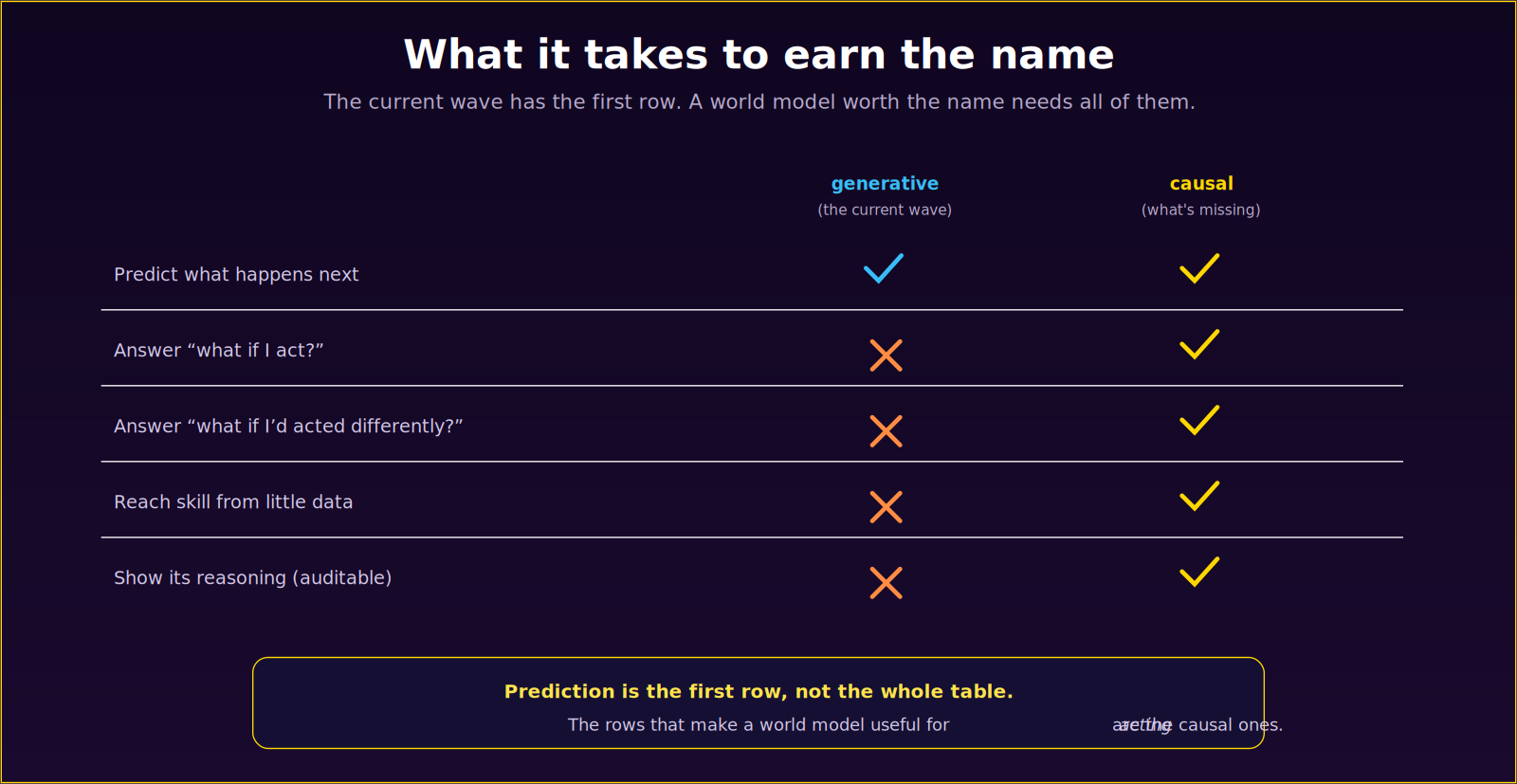
Put the capabilities side by side and the point is stark. A generative world model handles the first row — prediction — superbly. The rows beneath it are the ones that make a world model trustworthy for an agent that acts in a costly, regulated, or physical setting: answering interventions, reasoning counterfactually, reaching competence from limited real-world data, and being able to show why it expects an outcome. Those rows come from causal structure, not from scale.
Why this matters now, not later
The reason to be precise about this is timing. World models are converging with agentic AI and robotics — the whole point of the current push is to build systems that act, from humanoid robots to autonomous vehicles to embodied agents. That convergence is exactly the moment the prediction-versus-causation gap stops being philosophical. An agent choosing an action needs to know the consequence of that action, including in situations no dataset covered. A model that can only predict the likely-looking next frame will, at the critical moment, hand it a beautiful hallucination.
None of this is a knock on the world-model wave — it’s a statement about what will separate the systems that generate impressive demos from the ones you can actually deploy where a wrong action is expensive. The demos are won by prediction. The deployments will be won by causation.
The bottom line
World models are the right frontier, and the field is right to be excited. But a world model that only predicts is a world model in name only — it captures how the world looks, not how the world responds. The missing piece isn’t more data or more parameters. It’s causal structure: the thing that turns a stunning video generator into a system that knows what its actions will do. That’s the world model worth building — and it’s the one the moment is quietly asking for.