Ask a frontier language model a hard physics question today and it will likely nail it. The latest models score near-perfect on university-level classical mechanics, electromagnetism, and quantum problems; some now reach gold-medal performance on Physics Olympiad exams. Native multimodality has closed a gap that dogged earlier systems — they can read a diagram, interpret a geometry, follow a figure. On text-based physics reasoning, the benchmarks are approaching saturation.
That is a genuine advance, and it’s worth taking seriously. But it also raises a sharper question, one the field is actively wrestling with: does solving physics problems mean a model understands physics? The honest answer is not yet — and the reason why points to where the real progress is happening.
Fluent about physics, not grounded in it
A language model meets the physical world through exactly one channel: text. Its entire acquaintance with gravity, momentum, and friction comes from how those things are described in the words it trained on. That is an indirect, second-hand representation — the language of physics, not the mechanism.

The tell shows up the moment you ask a model to produce a physical world rather than talk about one. Even the best video-generation models still let a tipping glass hold its water, or a dropped object drift, because there is no conservation law underneath the pixels — only a very good sense of what such a scene usually looks like. The prose is flawless; the world it implies can be impossible. A model can describe momentum conservation perfectly in a sentence and violate it in the very next frame it renders, and it has no internal check that would notice. This is the crux of a live debate: some argue enough scale and better architectures will close the gap, while critics counter that a system trained only on text can reason about causation without ever having experienced cause and effect.
Where the advances are actually coming from
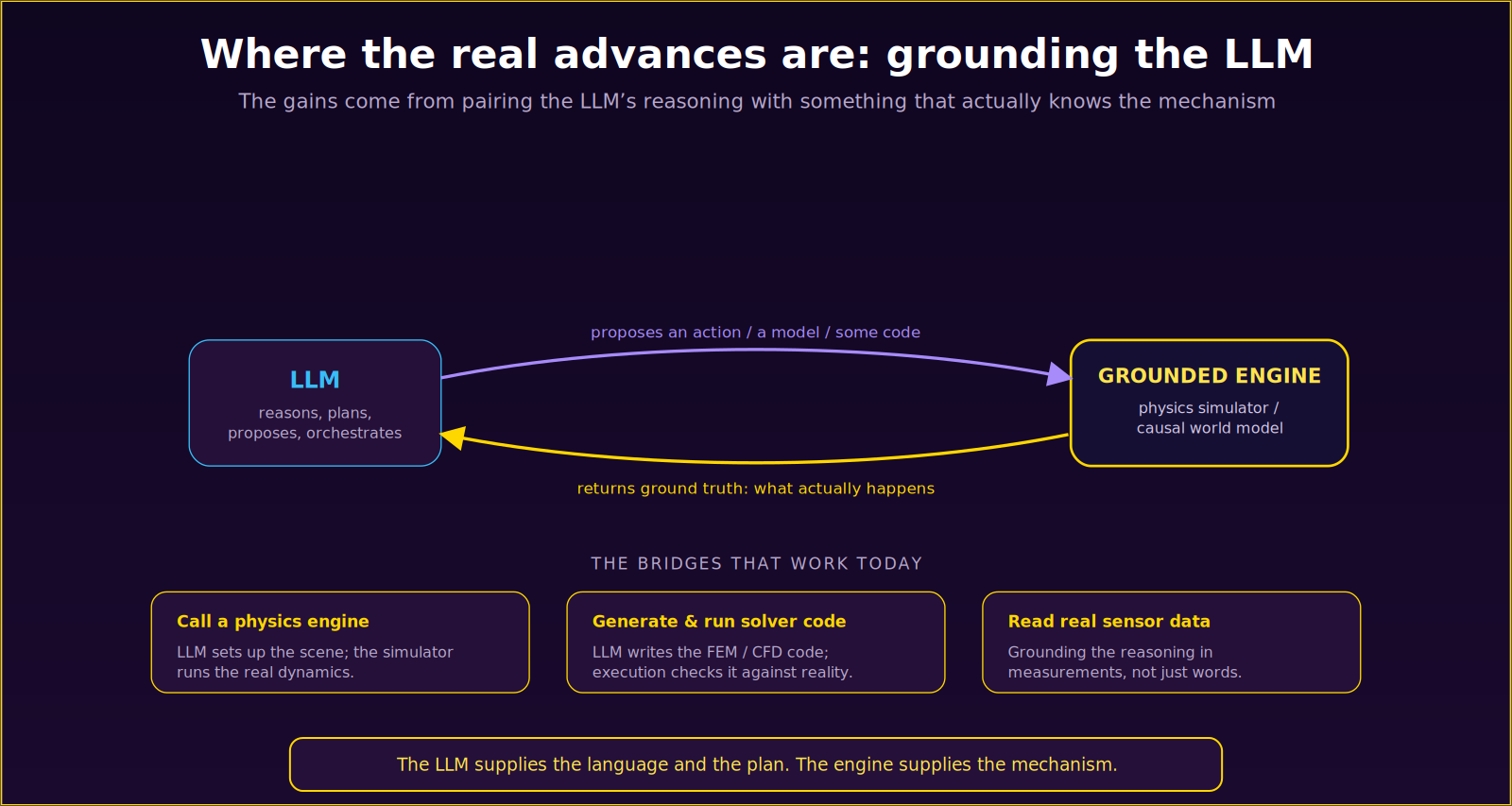
Here is the more useful observation. The most striking recent progress in LLMs-for-physics doesn’t come from the LLM alone getting bigger. It comes from grounding it — pairing the model’s reasoning with something that actually knows the mechanism.

Three bridges dominate the recent work, and they share a shape. In one, the LLM sets up a scene and hands it to a physics engine that runs the real dynamics — recent systems even use the model to infer physical parameters like mass and friction, then let a simulator do the physics. In another, the LLM generates the numerical code — finite-element or fluid-dynamics solvers — and execution against ground truth is what verifies it; new benchmarks exist precisely to test whether models can write scientifically valid simulation code. In a third, the model is fed real sensor data so its reasoning is anchored to measurements rather than to words about measurements.
In every case the pattern is identical: the language model contributes what it is genuinely good at — reading the problem, planning, proposing, orchestrating, writing code — and an external, grounded engine contributes the thing the LLM lacks: a faithful model of how the system actually responds. The LLM talks. The engine knows.
The missing half is a model of the mechanism
Read that pattern closely and it tells you what the LLM is missing, precisely. It isn’t more physics facts — it has those in abundance. It’s a grounded, queryable model of consequence: a representation of what happens to a physical system when something changes, that respects the underlying laws rather than the surface statistics of how they’re described. That is exactly what a physics engine provides in the narrow case, and exactly what a causal world model generalizes: a foundation that captures how a system responds to intervention, so that “what if this changed?” returns an answer bound by mechanism, not by the phrasing of the training data.
Seen this way, the LLM and the world model aren’t rivals; they’re complementary halves. The language model is a superb interface and reasoner — the part that understands the question and coordinates the work. The causal world model is the grounded engine of consequence — the part that actually knows what the physical system will do. The advances that impress most are the ones already stitching these two together.
The bottom line
LLMs have gotten remarkably good at the language of the physical world, and that’s genuinely useful. But talking about physics and modeling physics are different capabilities, and the gap between them doesn’t close by adding parameters — it closes by adding grounding. The trajectory of the best recent work is clear: the future of AI for the physical world is not the LLM alone, and not the world model alone, but the LLM reasoning on top of a grounded, causal model of how the world responds. One supplies the words. The other supplies the world.

Leave a Reply