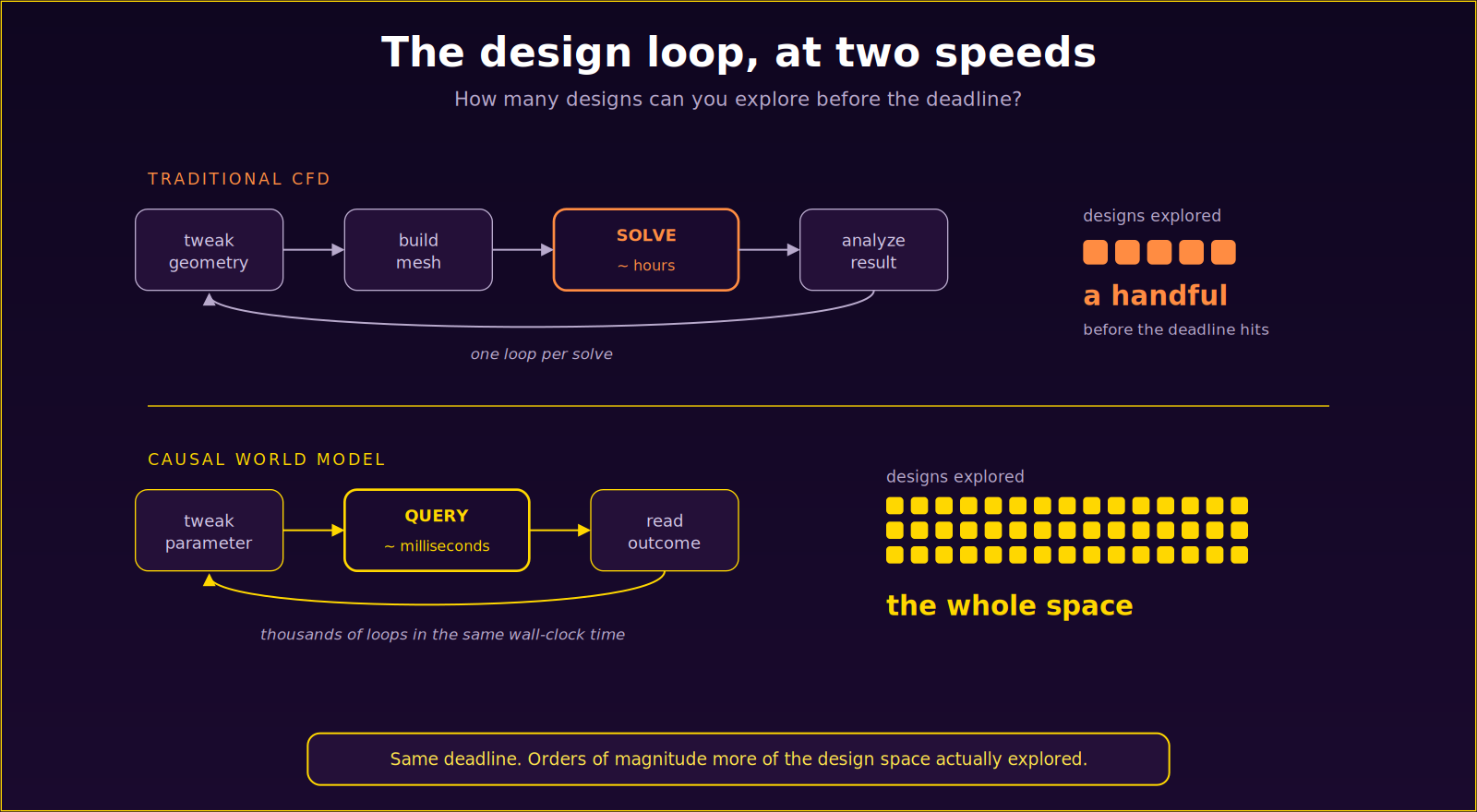
Every aerodynamicist knows the ritual. Tweak the geometry. Rebuild the mesh. Launch the solver. Wait — sometimes minutes, often hours, occasionally overnight — while it churns through millions of cells resolving the flow. Read the result. Then, having learned one thing about one design, tweak the geometry again and start the whole ritual over.
Computational fluid dynamics is one of the great achievements of applied mathematics. It is also, as a design tool, agonizingly slow — and the slowness isn’t incidental. It sits directly on the critical path of every decision an engineer wants to make.
The real bottleneck isn’t the solver. It’s the loop.
The problem isn’t that a single CFD solve is slow, exactly. It’s that design is inherently a game of many solves — a search across shapes, angles, and operating conditions — and the solver has no memory. Each run resolves the governing equations from scratch and then forgets everything the instant it finishes. The hours you spent understanding one configuration teach the solver nothing about the next.

So the design space you can actually explore is bounded not by your imagination but by your compute budget and your calendar. You test the handful of configurations you can afford to solve, pick the best of those, and quietly hope the real optimum wasn’t sitting in one of the thousand designs you never had time to run.
What a causal world model changes
A causal world model of a fluid system flips the economics. Instead of re-solving the equations for every question, you build a model once that captures how the flow responds to change — and then you query it.
Ask it what if the angle of attack increased by two degrees? or what if this fillet radius grew? and it returns the answer — the forces, the flow field — in a single forward pass, at inference speed rather than solver speed. The overnight solve becomes a millisecond query. And because a query is nearly free, you stop rationing your questions. You sweep the entire design space instead of sampling four points from it.

Why it has to be causal, not just a fit
Here is where most machine-learning surrogates for CFD quietly fail — and where the word causal earns its keep.
A surrogate trained to interpolate between solved cases looks superb inside the region it was trained on. Push it into a regime it never saw — a steeper angle near stall, an unusual combination of conditions — and it fabricates a smooth, confident, wrong answer, because it only ever learned the shape of the data, not the physics underneath it. For design exploration, that’s precisely the wrong failure mode: the interesting designs are usually the ones outside what you’ve already tested.
A causal world model behaves differently at the boundary. Because it captures the mechanism — how the underlying variables actually drive the flow — it extrapolates in a way a curve-fit cannot. It can predict the onset of a stall it was never explicitly shown, because it models why lift behaves as it does, not merely what it did at the points you solved. That’s the difference between a surrogate you can only trust inside the box and one you can use to explore beyond it.
What this unlocks
Collapse the cost of a “what if” from hours to milliseconds and whole workflows change shape:
- Design exploration becomes a real search rather than a lucky sample — thousands of configurations evaluated where you used to afford a dozen.
- Optimization gets tractable, because an optimizer that needs to evaluate the objective thousands of times can finally do so.
- Inverse design — what geometry would give me this lift-to-drag ratio? — becomes practical, because a model that runs forward in a millisecond can be run backward too.
- Real-time and control applications open up that were simply impossible when every evaluation meant a solver run.
The bottom line
CFD isn’t going away, and it shouldn’t — high-fidelity solvers remain the ground truth. But re-solving from zero for every question an engineer wants to ask was never the goal. The goal was always to understand how the design responds to change. A causal world model captures that understanding once and then answers instantly — turning aerodynamic design from a slow sequence of expensive solves into a space you can actually explore.
Solve it once. Ask it anything.