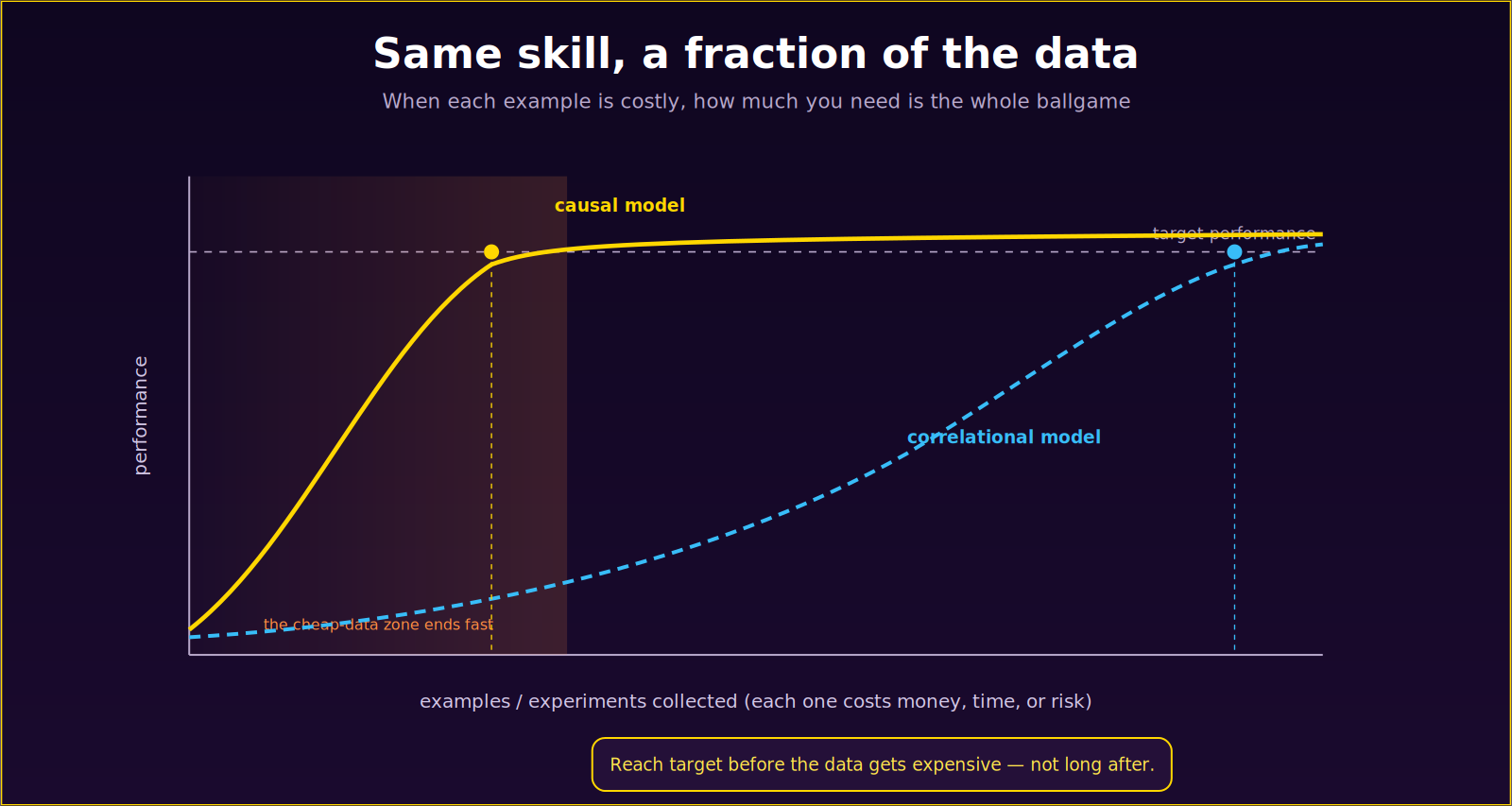
Every AI system runs on data, but not every system runs on the same amount of it — and in the real world, that difference decides what is possible. Where data is abundant and cheap, a data-hungry model is fine. Where each example costs a wet-lab run, a wrecked prototype, a month of a physical robot’s time, or is simply rare by nature, the amount of data a model needs stops being a technical footnote and becomes the entire constraint.
Data efficiency — getting more skill from fewer examples — isn’t a nice bonus. In the domains that matter most, it is the thing that determines whether a project ships at all.
Why most AI is data-hungry
The dominant paradigm learns by correlation: show a model enough examples of what tends to go with what, and it interpolates between them. This works astonishingly well — as long as you can feed it enough examples to cover the space. The catch is in that last clause. A model that learns patterns rather than mechanisms has to see a pattern to know it. Every new combination of conditions is, to a correlational model, a new thing to be observed.

Picture the space of situations a model might face as a grid of cases. A correlational model needs an example in nearly every cell, because it has no way to know what happens in a cell it hasn’t seen. A causal model works differently: from a handful of cells it recovers the underlying rule — the mechanism that generates the outcomes — and once it has the rule, it covers the cells it never sampled. Understanding the mechanism is what lets it generalize to cases that were never in the data.
What that buys you
Because a causal model reasons about why a system behaves as it does, it extracts more from every single example. The same skill that would take a correlational model a mountain of data is reached from a fraction of it.

That matters precisely where data is dear. In robotics, every trajectory costs wear, time, and risk on real hardware — a causal, model-based approach reaches target skill in a fraction of the environment steps a model-free method needs. In biotech, each data point can be a wet-lab experiment measured in weeks and dollars, so a model that can rank what to test before testing it is worth an enormous amount. In rare-event domains — fraud, failures, tail risk — the important cases are scarce by definition, and a model that can reason rather than memorize is the only kind that works. And everywhere there is a cold start, a causal prior means you don’t begin from zero.
A prior that pays off
None of this is free — building a model that reasons about cause is harder than fitting a curve to a pile of data. But it is a cost paid once, and it buys a structural advantage that compounds. A causal model that has learned how a system works can be pointed at a new but related task and start from a running head start, because the mechanism it already understands still applies. The correlational model, by contrast, starts each new task back at the bottom of its data mountain.
The bottom line
When data is cheap and endless, data efficiency is a luxury. When data is expensive, scarce, or dangerous to collect — which is to say, in most of the problems worth solving in the physical and regulated world — it is the whole game. A model that reasons about cause doesn’t just perform better. It performs better on less, and that is often the only kind of better that ships.