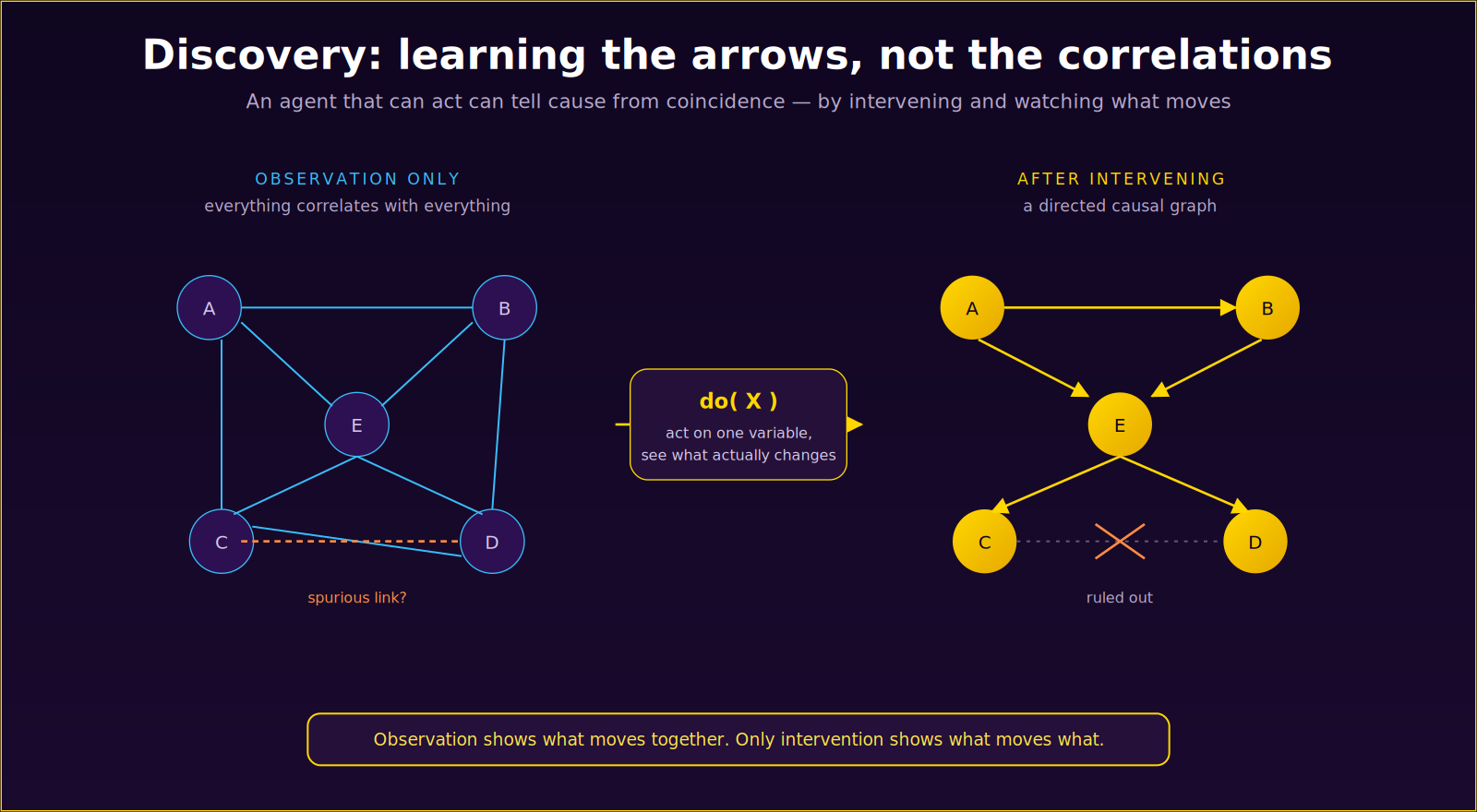
A reinforcement learning agent is, whether it knows it or not, running experiments. Every action it takes is an intervention on the world — a deliberate do this — followed by an observation of what happened next. That is the exact shape of a causal experiment. An RL agent is a scientist that never stops poking its environment to see what moves.
Which makes it strange that most RL throws that gift away. Standard agents learn a policy by correlating states, actions, and rewards — soaking up statistical associations without ever asking which of them reflect cause and which are coincidence. It works, eventually, but it is why so much of RL is brittle, data-hungry, and prone to learning the wrong lesson. For robotics, where every sample costs real time on real hardware, “eventually” is a luxury no one can afford.
Two problems: inference and discovery
Causality shows up in two distinct forms, and it’s worth keeping them apart.
Causal inference assumes you already know the structure — you know that pressing the accelerator causes the car to speed up — and asks: what is the effect of this action? Given the causal map, estimate the consequences of intervening.
Causal discovery is the harder, earlier problem: you don’t know the structure, and you have to learn it. Which variables influence which? Where do the arrows point? An agent dropped into an unfamiliar environment faces exactly this — it must figure out the mechanics of its world before it can exploit them.

Here is where RL’s nature becomes an advantage rather than an afterthought. Causal discovery from pure observation is notoriously hard — from watching alone, you often can’t tell whether A causes B, B causes A, or something hidden drives both. But an agent that can act can break that symmetry. It intervenes on one variable, watches what shifts downstream, and reads off the direction of causation directly. The ability to experiment is precisely what turns an ambiguous tangle of correlations into a directed causal graph.
Why RL is secretly a causal problem
Once you look for it, causal structure is hiding inside every hard problem in RL.
Credit assignment. When a reward finally arrives, which of the hundred earlier actions actually caused it? This is a causal question wearing an RL costume. Agents that reason about cause can assign credit to the action that mattered instead of smearing it across everything that happened to precede the reward.
Spurious correlations and confounding. An agent trained where a yellow floor always accompanied a reward may “learn” that yellow floors are good. Change the décor and the policy collapses. It latched onto a correlate of the cause, not the cause. Causal reasoning is the antidote to exactly this failure — it separates what reliably produces the outcome from what merely traveled alongside it.
Generalization and transfer. Surface statistics don’t survive a change of environment; causal mechanisms often do. A policy built on the causal structure of a task — how forces produce motion, how motion produces reward — carries over to new tasks that share that structure, because it learned the physics of the situation rather than the wallpaper.
Planning by imagination. An agent with a causal model of its world can simulate an action’s consequences before committing to it — rolling out counterfactuals internally and choosing the branch that leads somewhere good. This is model-based RL at its best: think before you act, using a model that actually knows what causes what.
Why robotics needs this most
Everything above matters double in robotics, for one blunt reason: real-world data is expensive. Every trajectory costs wear, time, and risk. You cannot let a physical robot flail through millions of episodes the way a simulator can.

Because a causal agent reasons about why the system behaves as it does — rather than memorizing what tended to work — it extracts more from every interaction. It explores where the uncertainty about cause actually lives, instead of wandering at random. In practice this shows up as a sharp cut in the experience needed to reach a given level of skill: across standard control benchmarks — CartPole, Pendulum, MountainCar, LunarLander — a causal, model-based approach reaches target performance in roughly two to three times fewer samples than a model-free baseline.
Sample efficiency is only half of it. The other half is trust. A robot acting near people has to be predictable and, when something goes wrong, explainable. A causal model can say why it expected an action to be safe — it carries the chain of cause behind its decisions. A black-box policy that happened to work in the lab offers no such account, which is exactly why black boxes are hard to deploy where the stakes are physical.
The bottom line
RL already has the one thing causal reasoning most needs: the ability to intervene. An agent that treats its actions as experiments — that discovers the causal structure of its world and then reasons over it — learns faster, transfers further, and can explain itself when it counts.
Prediction learns what usually happens. Causal RL learns what its actions actually do. For anything that has to act in the real world, that difference is everything.