Most machine-learning models are frozen the moment they finish training. From that point they only decay — the world drifts, the data ages, and the model that was state-of-the-art on launch day slowly becomes a liability. You paid for it once; it depreciates from there like any other fixed asset.
A causal world model built to enrich itself is a different kind of thing entirely. It doesn’t sit still after training. It runs a loop — probing its own weak spots, testing them, and folding what it learns back into a shared core — so that every interaction leaves it a little sharper than before. Instead of depreciating, it compounds. That single difference is, we think, the most important thing about how these systems are built.
The loop
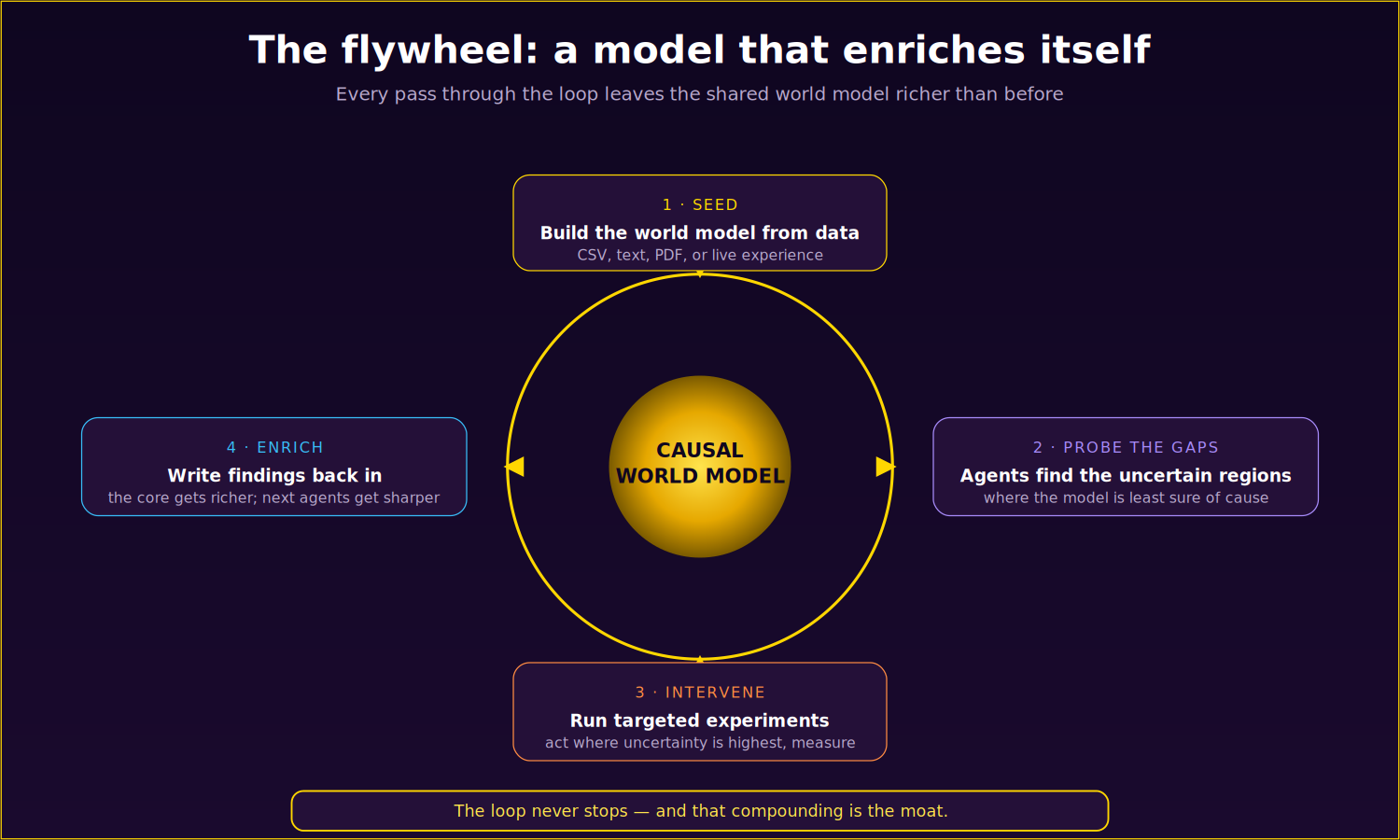
The mechanism is a flywheel: four stages that feed each other and never stop turning.

Seed. It starts with a world model built from whatever you have — a CSV, a document, a stream of live experience. The platform extracts causal structure and turns it into a queryable map of what causes what. No training from scratch, no hand-labelling.
Probe the gaps. This is the part that makes the loop intelligent. A population of causal agents trains automatically on the world model and goes looking for the regions where it is least certain — the corners where the causal structure is thin or ambiguous. Rather than gathering more of the data it already understands, the system hunts for what it doesn’t.
Intervene. Where a purely observational system would have to wait and watch, a causal agent can act. It runs targeted interventions exactly at those uncertain regions — small experiments designed to generate the one piece of signal the model is missing. This is active learning with a causal spine: the agent doesn’t just sample more, it samples where it matters.
Enrich. Every result folds back into the shared core. The model gets richer, its causal map gets more complete — and because the model is now sharper, the next generation of agents probes more precisely and asks better questions. The loop tightens on itself.
Why this compounds — and why that’s a moat
Put those four stages on repeat and something economically unusual happens. The model doesn’t just improve; it improves at an accelerating rate, because each pass makes the next pass more effective.

Contrast that with a conventional model’s trajectory: a burst of improvement during training, a plateau, then slow decline as reality moves on. The self-enriching model has no such ceiling. Every interaction — every query, every deployment, every experiment an agent runs — is a deposit into the same compounding core.
The competitive consequence is a widening gap. A rival can copy an architecture or license a dataset, but they cannot copy the accumulated result of a loop that has been running and enriching itself for a year. The lead isn’t a head start you can buy; it’s a compounding balance that grows with every use. That is what makes it a moat rather than a feature.
One core, every domain
There’s a second multiplier hiding in this design. Because the enrichment feeds a shared causal core rather than a stack of one-off models, the learning paid for in one place is available everywhere.
The expensive part of causal modeling — understanding how a change ripples through a system — is a cost paid once and then reused. A structural insight discovered while an agent probes a control task doesn’t stay locked in that task; it strengthens the same foundation that a fintech or biotech application draws on. Every domain runs on the one core, and every domain’s interactions feed it. The flywheel doesn’t spin for a single product. It spins for all of them at once.
The bottom line
A model that ships and then decays is a depreciating asset. A model that probes its own uncertainty, experiments to resolve it, and folds the answer back into a shared core is an appreciating one — it is worth more next quarter than it is today, and worth more still the quarter after that.
Prediction models get stale. A self-enriching causal world model gets better the more it is used. In a field where everyone is racing to train the biggest static snapshot, the more interesting question is which model is still learning after the training run ends.