Why physics needs a world model
For generations, simulating a physical system has meant one thing: write down the governing equations and solve them. Navier–Stokes for a fluid, the heat equation for a thermal field, the equations of motion for a structure under load. Then discretize space into a mesh, step forward in time, and let a numerical solver grind through the arithmetic. It works. It has put aircraft in the sky and bridges across rivers.
It is also slow, expensive, and strangely forgetful.
Every time a question changes — a slightly different inlet velocity, a new material, a wing that is two degrees steeper — the solver starts over. The hours of computation that answered the last question tell it nothing about the next one. A CFD run that took a day to converge has learned nothing it can reuse. Ask a thousand variations and you pay for a thousand full solves. For anyone doing design exploration, optimization, or real-time control, this is the wall everything runs into.
The question worth asking is not “how do we solve the equations faster?” It is “why are we re-solving them at all?”
What a world model changes
A world model is a learned, queryable representation of how a system behaves. Instead of re-deriving the outcome from first principles every time, you build a model once that captures how the system responds to change — and then you query it.
The shift is from solving to asking. With a numerical solver, a new boundary condition means a new simulation. With a world model, it means a single forward pass: what if this parameter moved? The answer comes back at the speed of inference, not the speed of a solver. Design iterations that took a day collapse to seconds. Sweeping a thousand configurations becomes cheap enough to actually do.
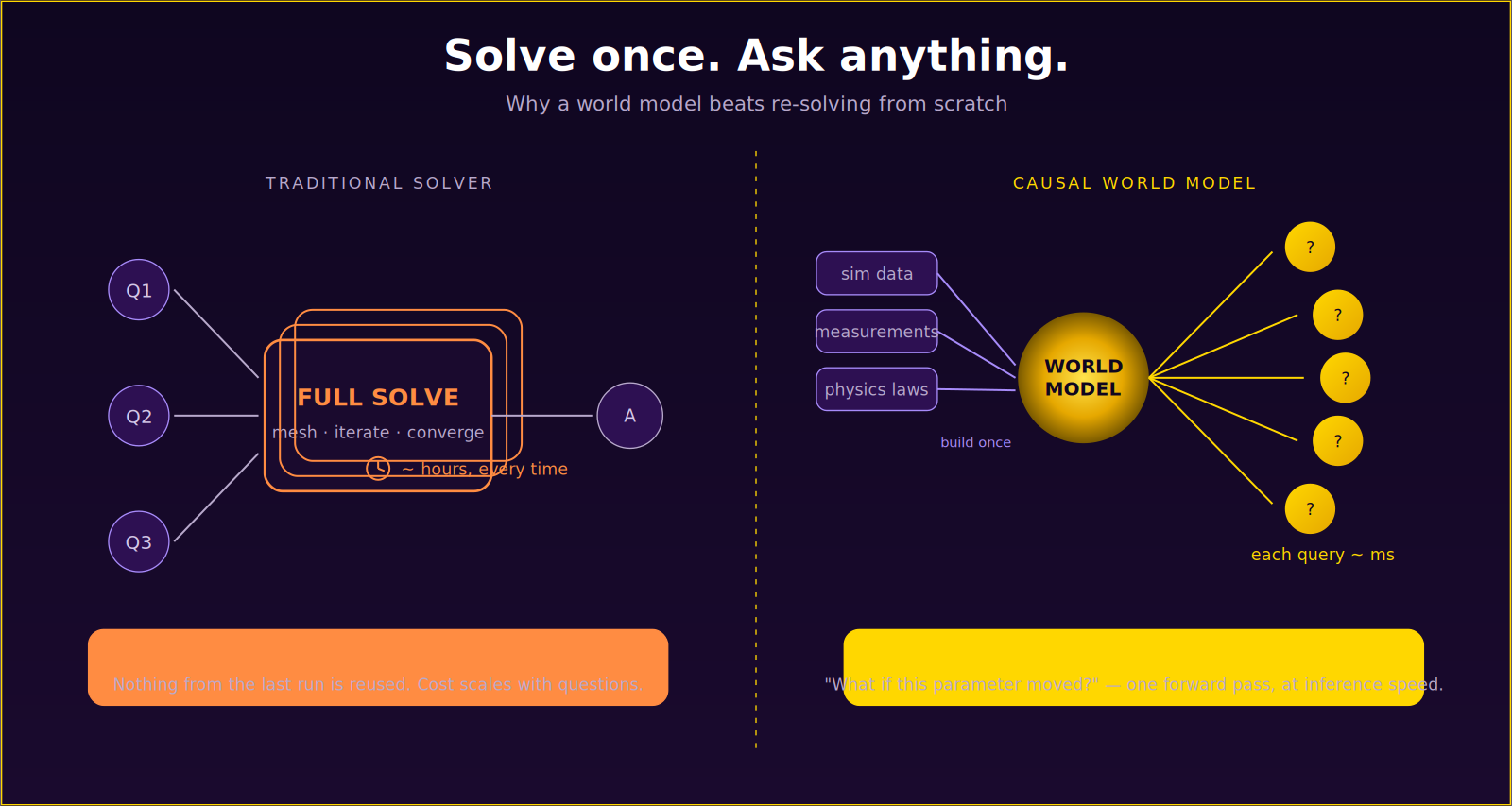
This is what makes world models matter for physical phenomena specifically. Physical systems are not random. They are governed by conservation laws and differential equations — deep, reusable causal structure that holds across every scenario you might throw at the system. A solver rediscovers that structure from scratch on every run. A world model learns it once and keeps it. The expensive part — understanding how a change ripples through the system — is paid a single time and then reused everywhere.
Where AI comes in
AI is what makes this practical rather than aspirational.
The job of learning a compact model of a complex physical system — one that generalizes to conditions it wasn’t explicitly shown — is exactly the kind of problem modern machine learning is built for. Given simulation data, experimental measurements, or both, a model can learn the mapping from inputs (geometry, material properties, boundary conditions) to behavior (flow fields, stresses, temperatures) and interpolate intelligently between them.
But there’s a catch, and it’s the one that separates a useful world model from an expensive party trick.
Most machine-learning surrogates learn correlation. They memorize what tended to happen in the training data. Inside that distribution they look brilliant. Push them slightly outside it — a regime they never saw, a combination of conditions that didn’t appear in training — and they fail quietly and confidently. For physics, where the entire point is often to explore conditions you haven’t observed yet, a surrogate that only interpolates is not enough.
This is why the modeling has to be causal, not merely predictive.
Prediction is not understanding
There is a difference between a model that predicts and a model that understands.
A predictive model answers: given inputs like these, what output usually follows? A causal world model answers something stronger: if I intervene and change this, what will actually happen as a consequence? The first is a lookup table with good manners. The second is a model of the mechanism.
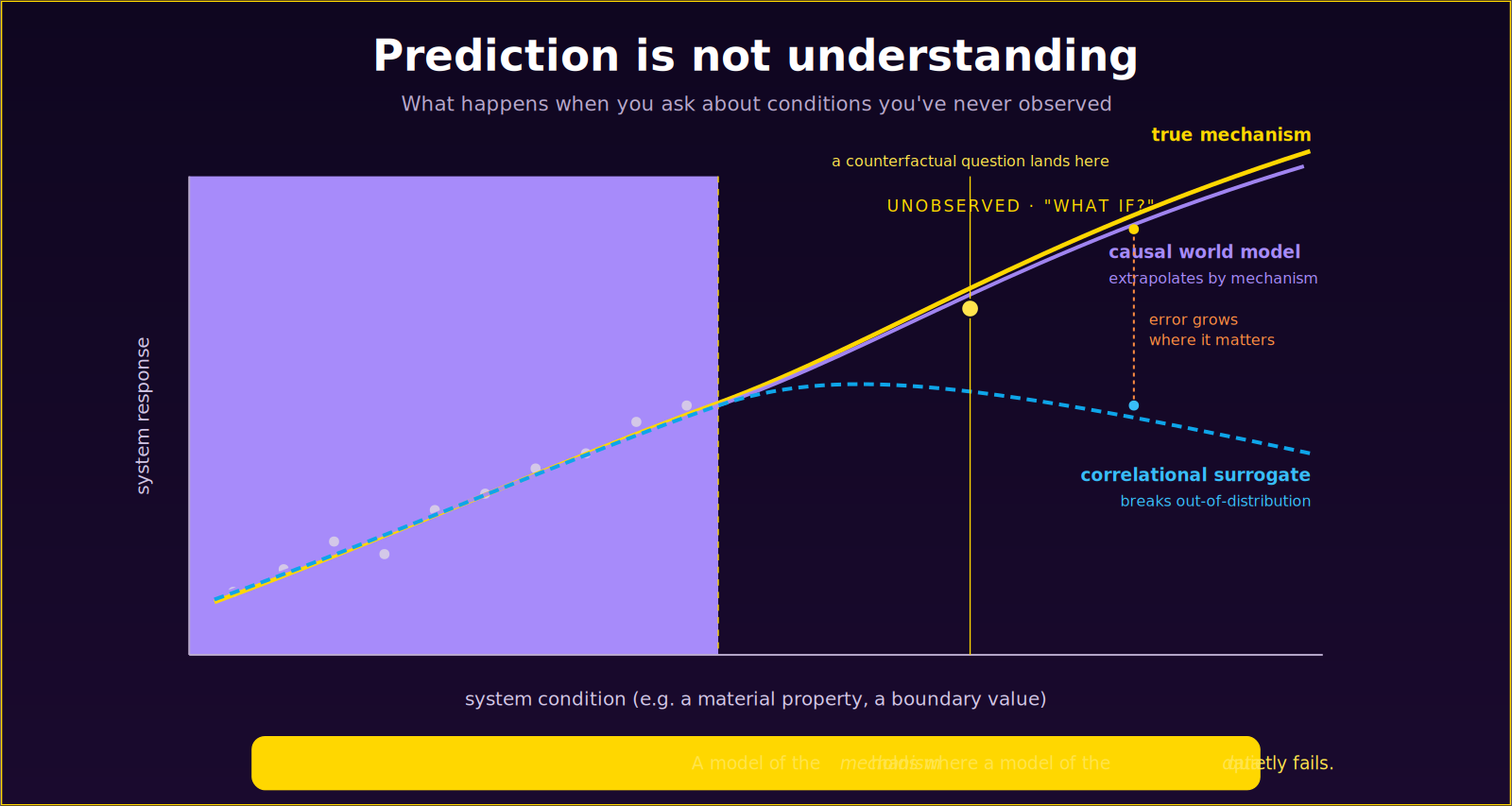
As Figure 2 shows, the two approaches are indistinguishable inside the training region — and completely different outside it. For physical phenomena, the mechanism is the whole game. When you ask “what happens if this material property shifts?” you are not asking what the training data did — you are asking a counterfactual, a question about a world that hasn’t been observed. Only a model that has captured the causal structure of the system — the actual chain of cause and consequence — can answer it and be trusted when it does. A causal world model extrapolates because it reasons about why the system behaves as it does, not just what it did last time.
That trust matters twice over. It matters for accuracy: causal models hold up in the out-of-distribution regimes where correlational surrogates quietly break. And it matters for adoption. An engineer signing off on a design, or a scientist deciding which experiment to run, needs more than a number — they need the chain of reasoning behind it. A world model that can show its causal work is one you can actually build on.
The payoff
Put these together and the picture is concrete. Counterfactual physics at the speed of inference. Design spaces you can sweep in an afternoon instead of a quarter. Inverse problems — what conditions would produce this outcome? — that become tractable because the model runs backward as easily as forward. Real-time control loops that were impossible when every step required a full solve. Digital twins that answer “what if” instead of merely replaying “what was.”
The equations of physics aren’t going anywhere. But re-solving them from zero, over and over, for every question we want to ask — that was never the point. The point was always to understand how the system responds to change. A causal world model is what that understanding looks like when you can query it.
Solve it once. Ask it anything.