The center of gravity in AI is shifting. For years the goal was a better predictor — a system that, shown the world so far, tells you what comes next. Now the ambition is agentic: systems that don’t just describe the world but plan in it, make decisions, and take actions on our behalf. That shift sounds incremental. It isn’t. It exposes a gap that no amount of predictive power fills on its own.
The gap is this: a model that can predict the world cannot, by that fact alone, tell you what will happen when it acts on the world. Prediction and action are different in kind, and agentic AI is the point where that difference stops being academic.
Why prediction runs out
Today’s most capable models are extraordinary predictors. Trained to anticipate the next token, the next frame, the next value, they capture the statistical shape of the world with uncanny fidelity. But prediction answers only one question: what usually comes next? It is a model of how the world tends to unfold when left alone.

An agent breaks that stillness. It reaches in and changes things — and the moment it does, it needs to know not what usually happens, but what happens because it acted. A pure predictor has no representation of intervention. Ask it what follows from an action no one in its training data ever took, and it answers from a world where no one took it. It will give you a confident, fluent, and possibly disastrous guess, and it has no way to know the guess is out of its depth. That is a fine failure mode for a system that only describes. It is a dangerous one for a system that acts.
What a model of consequence adds
What an agent needs is a model of consequence — a representation of what its actions cause, not merely what tends to co-occur. With one, the agent can do the thing that separates deliberate action from reflex: it can imagine.

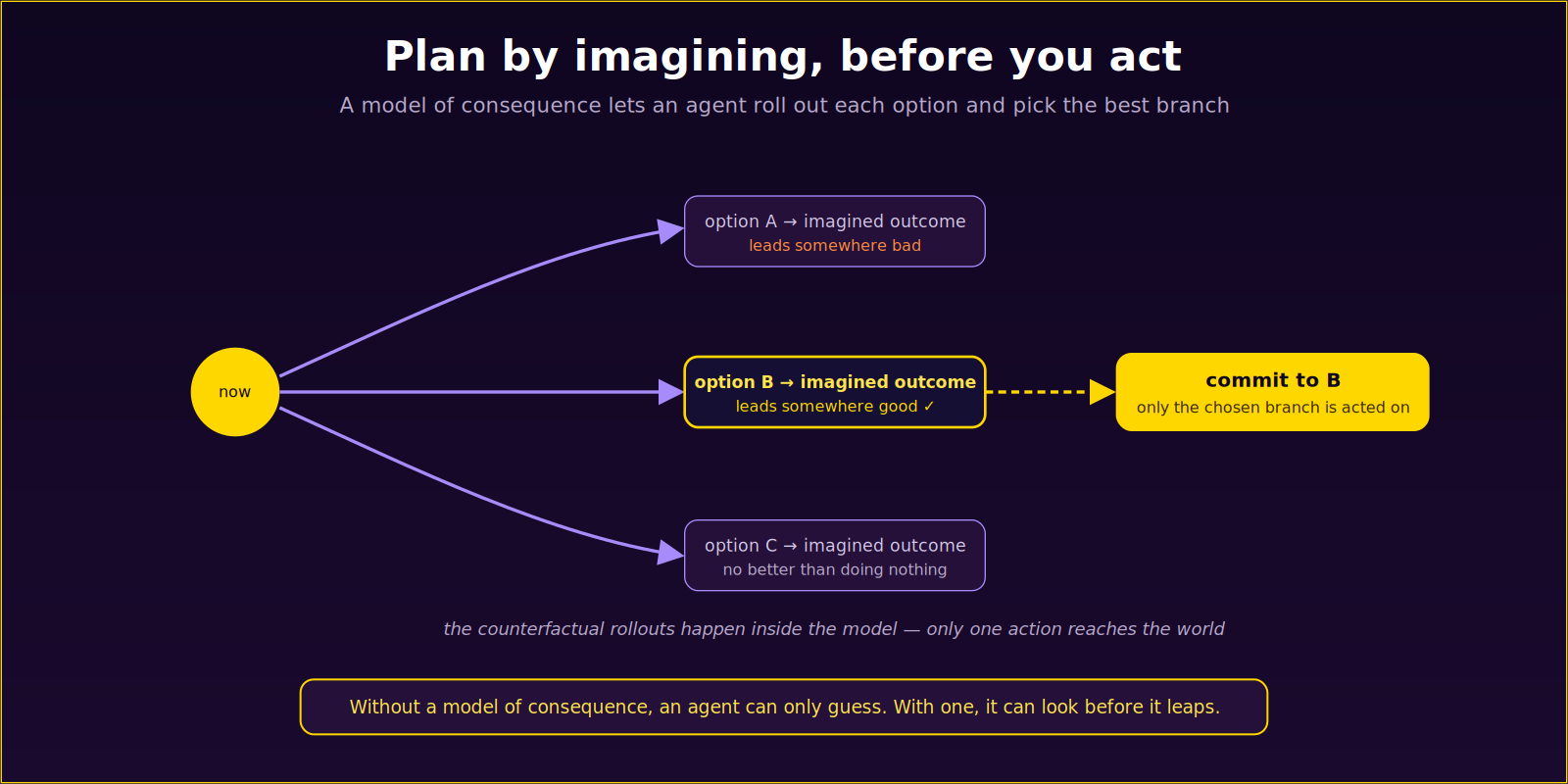
Given a decision, an agent with a model of consequence can roll out each option inside the model — simulating where option A leads, where B leads, where C leads — and commit only to the branch that ends somewhere good. The exploration happens in imagination; only the chosen action reaches the world. This is planning in the truest sense, and it is exactly what a predictor cannot do, because choosing between actions requires knowing the consequence of each, and consequence is not something you can read off a correlation.
Why this is the question of the moment
This is why the rise of agentic AI makes causal modeling urgent rather than optional. As long as AI only had to describe, a Level-1 predictor was enough, and the gap stayed hidden. The instant we ask these systems to act — to plan, to decide, to be trusted with consequences — the gap becomes the whole problem. Scaling a predictor makes it a better predictor. It does not turn it into a model of consequence; that is a different capability, built differently.
The industries where agentic AI could matter most — finance, healthcare, robotics, industrial control — are also the ones where a wrong action is expensive or dangerous, and where you must be able to say why the action was chosen. They cannot run on confident guesses. They need agents that understand consequence.
The bottom line
An agent is only as good as its grasp of what its actions do. Prediction — the thing modern AI has largely mastered — tells you how the world looks. Agency demands something more: a model of how the world responds. Building that model of consequence isn’t a refinement of the predictive paradigm. It is the missing piece that agentic AI is now, unavoidably, asking for.